The Measures Taken
A defunct site housing papers, articles and lengthier disquisitions by Owen Hatherley, now blogging only at Sit down man, you're a bloody tragedy.Monday, January 23, 2006
Decadent Action
Vera Chytilova’s Daisies
‘for all those who are soured by the sight of trampled-down lettuce- only!’
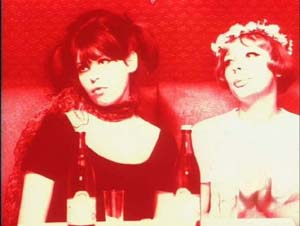
In a recent dissensus thread on film, the question of the place of anti-naturalism, Brecht, ‘laying bare the apparatus’ and other Measures Taken hobbyhorses came up a few times. One of the more common objections to this approach, which runs through the epic theatre to late 60s film and postpunk, is that without naturalism, representation and identification all one is left with is: intellectual aridity, political grandstanding, ‘greyness’- an argument that has much in common with the idea that, without capitalism, our society would be denuded of its colour, its abundance of sensations, its chaotic cities, its sexuality, and the hyperactivity of its culture industry. This is of course reinforced by the perception that the various forms of ‘actually existing socialism’ from 1917 to 1989 were one enormous bread queue, presumably in front of a grey concrete building housing a state bureaucracy of some description.
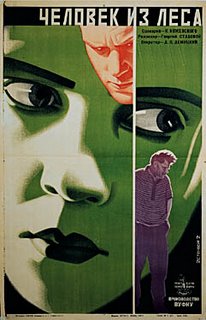
At various points in this history though, there are sudden outbreaks of violent colour, of an anti-naturalism which entirely sidesteps the international style and its Platonic greys and whites. Particularly violently there are the late 1920s posters of 2 Stenberg 2, sculptors turned movie advertisers. Without ever falling into the mere picturesque of art nouveau or its 60s revivals, their designs are dialectical juxtapositions in green and red, depictions of cinematic conflict by angle and gesture. Most striking in them is their implicit link between movement, futurist dynamism and colour- a synaesthesia that recurs here and there, such as in Eisenstein’s writings on contrapuntal colour, and in the ANS, an enormous synthesiser residing in the terrifying totalitarian-gothic edifice of the Moscow State University and most famously played by Eduard Artemeyev on the soundtracks to Solaris and Stalker, that relies essentially on ‘painting’ a sound, creating discrete, shimmering chromatic stabs.
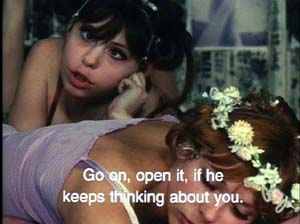
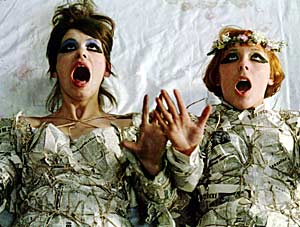
Or, from Czechoslovakia just prior to its brief experiment in ‘socialism with a human face’, there is the extraordinary formalism of Vera Chytilova’s 1966 film Daisies: one of the most stunning profusions of effects, colours, jarring techniques in cinematic history, a film utterly in love with its own aimless exuberance. The film has always been treated somewhat sniffily- either by the apparachtiks who banned it, or from western critics, for whom the film failed to fit into the sombre mode of the East European film- no struggles against a Kafkaesque bureaucracy, no method-acting male heroes, no interminable Kunderian love affairs-and an irritatingly ambiguous political import, as the film could be interpreted easily enough as Stalinist, consumerist, sexist, feminist or Anarchist, depending on one’s prejudice (the Time Out Film Guide is especially savage). More precisely, the director herself described it as being about ‘destruction or the desire to destroy’
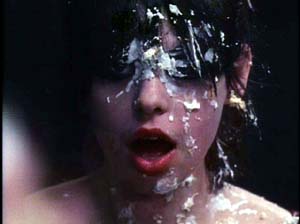
The plot, such as it is, follows two young women, ‘Marie 1’ and ‘Marie 2’ who decide (to a montage of newsreel footage of destroyed cities and collapsing buildings) that as the world is ‘spoiled’, so will they be. The acting reminds of the Constructivist infatuation with Chaplin, who incarnated their principles by transforming himself into a marionette (‘Chaplin is not human’- Gilbert Seldes). Similarly Marie and Marie decide that they are ‘dolls’, and act accordingly- in the opening scenes the movement of their joints sounds like the creak of a door, walking round the room produces a metallic clatter. Their ‘spoiling’ takes the form, first of all, of going on innumerable dinners with older men, in order to eat and drink as luxuriously as possible. This escalates until, eventually, they receive an extremely ambiguous comeuppance.
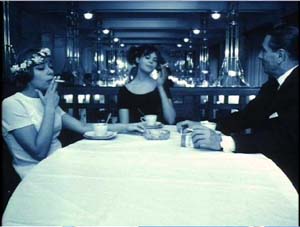
An example of how the film ‘works’ can be seen in the section where the two Maries go to see a restaurant to see a dance act. As an Eastern Bloc ragtime plays, a man and a woman give 20s-referencing dances, dressed in flapper-era garb. The girls get progressively more and more drunk and begin breaking things, annoying the other guests, etc. The dancers are suddenly unnerved, frown worriedly between their moves-the other customers make complaints, and Chytilova disrupts the action by constantly changing the colour filter, draping the restaurant either in an art film grey or in sudden, severe reds and greens, the beer flowing over the table becoming a kaleidoscope of coloured bubbles. The music is reminiscent of the dialectical film music advocated by Eisler and Adorno, which would be contrapuntal, work against whatever was on screen- the music playing is clearly from a live recording, and as the diners get more irked and the staff more disgruntled, there are ecstatic cheers and applause. The girls essentially make themselves a spectacle, create from their everyday life something more than passivity- the dance of destruction is slightly reminiscent of the end of Jacques Tati’s Playtime, though here without Tati’s humanism, without his sense of a public.
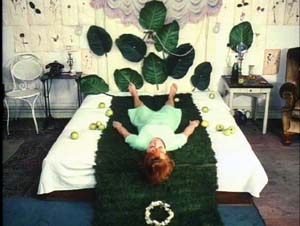
The film is a depiction of gross abundance and profligacy, and takes the same approach to its own construction. The effects that it uses are effectively there purely for themselves- take for instance a scene in which for no ostensible reason a train departing from a station is abstracted into kinetic, opposing, multicoloured lines- for no purpose other than kineticism and excitement. Appropriately for a film so brutally edited (it clocks in at around 70 minutes) the Maries are fixated with cutting, with taking a pair of scissors to everything from food to magazines, creating in their room an array of magazine photographs, scribbles, depictions of abundance- in one ecstatic scene this escalates to them chopping off each other’s limbs, heads, until in a scissor fight the entire frame is cut up into millions of tiny pieces, dancing around the screen. They secede from the human here decisively, their transformation making them no longer subject to the laws of physics.
‘‘Remember the one who kept asking ‘what will happen to us! What will happen to us!’?
‘The one who died?’’
As here described, Daisies might sound essentially like mere individualism, a joyous consumerist protest interrupted by a statist bureaucracy. The film was critiqued by its censors for similar reasons, literally for the amount of food squandered on screen. Chytilova maintained that in fact the film was a critique of consumerism taken to its limit- and however much the film might glory in its devourings, it would be difficult to find in it a simple celebration of state capitalist abundance. Rather, the film has many similarities with the Situationist critique of late capitalism. The Maries seem to constantly need to prove their own existence. In one scene finding a trail of their own half eaten vegetables they joyously march along chanting ‘we are, we are, we are!’- they can only define themselves if there is something that definitively bears their mark. At another point they seem to accidentally walk into a socialist realist film, as Czech men cycle down cobbled streets on their way to work in a romantically misty morning. Horrified, they realise that not one of them notices their presence.
Their action is essentially based on a kind of aggressive infantilism, on a total refusal of the adult world- though not in the sense of the infantilism that marks late capitalism, where one has to pretend to be 14 in order to cope with colossal working hours, etc- this is a total, utterly dogged and dangerous infantilism. For all their bikinis, short skirts and dating of various deluded men, Marie 1 and Marie 2 are totally asexual- in one scene one attempts a mock-seduction of a butterfly collector, though when finally at risk, pleads ‘do you have any food in the house? At least some jam perhaps?’ Instead it marks a colluding in their own commodification. At the film’s end, they seem to accidentally stumble on the military-industrial complex, and carry on their campaign of destruction therein. Straying accidentally into an imposing building, all bare ducts and pipes and warning signs on the wall, they walk into a food elevator, going past a kitchen, a symphony orchestra and then arrive at a table laid out for a rather unsocialist looking baroque banquet. The gleeful destruction of this is what finally elicits their censure, their punishment.

‘You really mean something serious? That something is?’
Bookending the film, somewhat obliquely, are images of huge, terrifying destruction, newsreel shot with the same demented chromatism as the rest of the film. A camera flies over a blitzed city. A missile connects with a ship, an atomic bomb explodes. Destruction takes various forms- the minor destructions perpetrated by the Maries, and the actual, life-destroying destruction carried out by power. There is no ostensible moral or conclusion in Daisies, presumably the reason for its unpopularity- if seen at all now, its generally seen as an odd, ‘psychedelic’ curio or as a piece of titillation. Rather, it is a film unique both in terms of its experimentalism- the film is sui generis, has had no noticeable trace in cinema since- and in its radical ambiguity. The shortages and grimness that supposedly characterise state socialism are totally absent, instead we have a society that could be easily transferred to our own- in which war and famine are endemic and smoking and eating too much salt are legislated against, in which an ever-present sexualisation masks a virulent puritanism, and in which deferred resistances are made by hyperactive conspicuous consumption. The difference is that the protagonists of Daisies refuse to stop at the point at which it becomes destructive- they consume and consume until finally power has to force them to stop.
‘for all those who are soured by the sight of trampled-down lettuce- only!’

In a recent dissensus thread on film, the question of the place of anti-naturalism, Brecht, ‘laying bare the apparatus’ and other Measures Taken hobbyhorses came up a few times. One of the more common objections to this approach, which runs through the epic theatre to late 60s film and postpunk, is that without naturalism, representation and identification all one is left with is: intellectual aridity, political grandstanding, ‘greyness’- an argument that has much in common with the idea that, without capitalism, our society would be denuded of its colour, its abundance of sensations, its chaotic cities, its sexuality, and the hyperactivity of its culture industry. This is of course reinforced by the perception that the various forms of ‘actually existing socialism’ from 1917 to 1989 were one enormous bread queue, presumably in front of a grey concrete building housing a state bureaucracy of some description.

At various points in this history though, there are sudden outbreaks of violent colour, of an anti-naturalism which entirely sidesteps the international style and its Platonic greys and whites. Particularly violently there are the late 1920s posters of 2 Stenberg 2, sculptors turned movie advertisers. Without ever falling into the mere picturesque of art nouveau or its 60s revivals, their designs are dialectical juxtapositions in green and red, depictions of cinematic conflict by angle and gesture. Most striking in them is their implicit link between movement, futurist dynamism and colour- a synaesthesia that recurs here and there, such as in Eisenstein’s writings on contrapuntal colour, and in the ANS, an enormous synthesiser residing in the terrifying totalitarian-gothic edifice of the Moscow State University and most famously played by Eduard Artemeyev on the soundtracks to Solaris and Stalker, that relies essentially on ‘painting’ a sound, creating discrete, shimmering chromatic stabs.

Or, from Czechoslovakia just prior to its brief experiment in ‘socialism with a human face’, there is the extraordinary formalism of Vera Chytilova’s 1966 film Daisies: one of the most stunning profusions of effects, colours, jarring techniques in cinematic history, a film utterly in love with its own aimless exuberance. The film has always been treated somewhat sniffily- either by the apparachtiks who banned it, or from western critics, for whom the film failed to fit into the sombre mode of the East European film- no struggles against a Kafkaesque bureaucracy, no method-acting male heroes, no interminable Kunderian love affairs-and an irritatingly ambiguous political import, as the film could be interpreted easily enough as Stalinist, consumerist, sexist, feminist or Anarchist, depending on one’s prejudice (the Time Out Film Guide is especially savage). More precisely, the director herself described it as being about ‘destruction or the desire to destroy’

The plot, such as it is, follows two young women, ‘Marie 1’ and ‘Marie 2’ who decide (to a montage of newsreel footage of destroyed cities and collapsing buildings) that as the world is ‘spoiled’, so will they be. The acting reminds of the Constructivist infatuation with Chaplin, who incarnated their principles by transforming himself into a marionette (‘Chaplin is not human’- Gilbert Seldes). Similarly Marie and Marie decide that they are ‘dolls’, and act accordingly- in the opening scenes the movement of their joints sounds like the creak of a door, walking round the room produces a metallic clatter. Their ‘spoiling’ takes the form, first of all, of going on innumerable dinners with older men, in order to eat and drink as luxuriously as possible. This escalates until, eventually, they receive an extremely ambiguous comeuppance.

An example of how the film ‘works’ can be seen in the section where the two Maries go to see a restaurant to see a dance act. As an Eastern Bloc ragtime plays, a man and a woman give 20s-referencing dances, dressed in flapper-era garb. The girls get progressively more and more drunk and begin breaking things, annoying the other guests, etc. The dancers are suddenly unnerved, frown worriedly between their moves-the other customers make complaints, and Chytilova disrupts the action by constantly changing the colour filter, draping the restaurant either in an art film grey or in sudden, severe reds and greens, the beer flowing over the table becoming a kaleidoscope of coloured bubbles. The music is reminiscent of the dialectical film music advocated by Eisler and Adorno, which would be contrapuntal, work against whatever was on screen- the music playing is clearly from a live recording, and as the diners get more irked and the staff more disgruntled, there are ecstatic cheers and applause. The girls essentially make themselves a spectacle, create from their everyday life something more than passivity- the dance of destruction is slightly reminiscent of the end of Jacques Tati’s Playtime, though here without Tati’s humanism, without his sense of a public.

The film is a depiction of gross abundance and profligacy, and takes the same approach to its own construction. The effects that it uses are effectively there purely for themselves- take for instance a scene in which for no ostensible reason a train departing from a station is abstracted into kinetic, opposing, multicoloured lines- for no purpose other than kineticism and excitement. Appropriately for a film so brutally edited (it clocks in at around 70 minutes) the Maries are fixated with cutting, with taking a pair of scissors to everything from food to magazines, creating in their room an array of magazine photographs, scribbles, depictions of abundance- in one ecstatic scene this escalates to them chopping off each other’s limbs, heads, until in a scissor fight the entire frame is cut up into millions of tiny pieces, dancing around the screen. They secede from the human here decisively, their transformation making them no longer subject to the laws of physics.
‘‘Remember the one who kept asking ‘what will happen to us! What will happen to us!’?
‘The one who died?’’
As here described, Daisies might sound essentially like mere individualism, a joyous consumerist protest interrupted by a statist bureaucracy. The film was critiqued by its censors for similar reasons, literally for the amount of food squandered on screen. Chytilova maintained that in fact the film was a critique of consumerism taken to its limit- and however much the film might glory in its devourings, it would be difficult to find in it a simple celebration of state capitalist abundance. Rather, the film has many similarities with the Situationist critique of late capitalism. The Maries seem to constantly need to prove their own existence. In one scene finding a trail of their own half eaten vegetables they joyously march along chanting ‘we are, we are, we are!’- they can only define themselves if there is something that definitively bears their mark. At another point they seem to accidentally walk into a socialist realist film, as Czech men cycle down cobbled streets on their way to work in a romantically misty morning. Horrified, they realise that not one of them notices their presence.

Their action is essentially based on a kind of aggressive infantilism, on a total refusal of the adult world- though not in the sense of the infantilism that marks late capitalism, where one has to pretend to be 14 in order to cope with colossal working hours, etc- this is a total, utterly dogged and dangerous infantilism. For all their bikinis, short skirts and dating of various deluded men, Marie 1 and Marie 2 are totally asexual- in one scene one attempts a mock-seduction of a butterfly collector, though when finally at risk, pleads ‘do you have any food in the house? At least some jam perhaps?’ Instead it marks a colluding in their own commodification. At the film’s end, they seem to accidentally stumble on the military-industrial complex, and carry on their campaign of destruction therein. Straying accidentally into an imposing building, all bare ducts and pipes and warning signs on the wall, they walk into a food elevator, going past a kitchen, a symphony orchestra and then arrive at a table laid out for a rather unsocialist looking baroque banquet. The gleeful destruction of this is what finally elicits their censure, their punishment.
‘You really mean something serious? That something is?’
Bookending the film, somewhat obliquely, are images of huge, terrifying destruction, newsreel shot with the same demented chromatism as the rest of the film. A camera flies over a blitzed city. A missile connects with a ship, an atomic bomb explodes. Destruction takes various forms- the minor destructions perpetrated by the Maries, and the actual, life-destroying destruction carried out by power. There is no ostensible moral or conclusion in Daisies, presumably the reason for its unpopularity- if seen at all now, its generally seen as an odd, ‘psychedelic’ curio or as a piece of titillation. Rather, it is a film unique both in terms of its experimentalism- the film is sui generis, has had no noticeable trace in cinema since- and in its radical ambiguity. The shortages and grimness that supposedly characterise state socialism are totally absent, instead we have a society that could be easily transferred to our own- in which war and famine are endemic and smoking and eating too much salt are legislated against, in which an ever-present sexualisation masks a virulent puritanism, and in which deferred resistances are made by hyperactive conspicuous consumption. The difference is that the protagonists of Daisies refuse to stop at the point at which it becomes destructive- they consume and consume until finally power has to force them to stop.
posted by owen hatherley # 4:18 AM 
Archives
May 2005 June 2005 July 2005 August 2005 September 2005 October 2005 November 2005 December 2005 January 2006 March 2006 April 2006 May 2006 June 2006 August 2006 September 2006 November 2006 February 2007 April 2007 May 2007 August 2007 November 2007 February 2008 June 2008 November 2008 January 2009 May 2009 June 2009 November 2009
did you agree to the measures taken?also
- Archinect
- Audacity
- Blueprint
- Building Design
- Frieze
- Historical Materialism
- MONU
- New Humanist
- New Statesman
- Nothing to See Here
- Perforations
- Socialist Review
- Socialist Worker
- The Weblog
- Wikipedia
- The Wire
- Ads Without Products
- Aloof From Inspiration
- Beyond the Implode
- Beyond Beyond the Implode
- Blissblog
- Degradation Ceremony
- End Times
- Entschwindet und Vergeht
- Fantastic Journal
- I Like
- The Impostume
- Infinite Thought
- Institute for Conjunctural Research
- Homo Ludens
- Kosmograd
- K-Punk
- Lenin's Tomb
- The Mire
- No Useless Leniency
- Poetix
- Screened Out
- Sea Songs
- Socialism and/or Barbarism
- Things Magazine
- Voyou Desoeuvre
- We Are Bad
- The Twentieth Century Society
- City of Sound
- The Sesquipedalist
- The Joy of Concrete
- no2self
- Architecture in Berlin
- City of Sound
- Entschwindet, das CV
- Dismantled King is Off the Throne
- SuperSpatial
- (what is this)
- Progressive Reactionary
- Russian Utopia Depository
- Maraid Design
- Sevensixfive
- Varnelis
- Architechnophilia
- Slab
- Part IV
- Strange Harvest
- Atelier A&D
- Archislave
- Candyland
- Flickr Brutalism
- From Here to Modernity
- Skyscraper City
- Monuments of the Future
- Archigram
- Chernikov Virtual Museum
- Chernikov Archive
- Gabion
- 0lll
- Shicklerart
- Constructivism in Arhitecture
- Unmitigated England
- YouTube Meades Shrine
- Enchanted Isle
- Boredom is always Counter-Revolutionary
- Antiflaneur
- Cracks in the Fabric
- Mapping Melbourne
- BLDGBLOG
- Lumpen Orientalism
- English Heretic
- Sub-Urban
- Punk Planning
- Subterranea Brittanica
- Diary of a Bluestocking
- Life without Buildings
- The Box Tank
- Condencity
- Nobody There
- Subtopia
- Metropolis
- aggregat4/5/6
- Architectures of Control
- The London Particular
- Ritual Landscape
- Dancing Bears
- Charles Holden
- London Destruction
- Derelict London
- Greenwich Phantom
- Classic Cafes
- London belongs to Me
- Transpontine
- Londonist
- Straight Outta Clapton
- London Transport Poster Archive
- Plakaty.Ru
- Revolution by Design
- Russian Poster
- Flickr USSR Posters
- Stefan Landsberger's Chinese Propaganda Poster Pages
- Russian Civil War Posters
- Stenberg Brothers
- Soviet Poster A Day
- The Poster Prop Page
- Russian Posters at allposters
- Militant Esthetix
- Savage Messiah
- Click Opera
- Snegourotchka
- New Plastic Ideas
- Modern Missives
- The Beasthouse
- Eurhythmania
- Petite Sophist
- Missing Dust Jacket
- Au carrefour étrange
- Triangular Sun
- Paperpools
- Feast of Palmer
- Cinders and Dust
- American Stranger
- Culturemonkey
- Enthusiasm
- Tom Roper's Weblog
- And you may find yourself...
- Rabbits, Toyen and so forth
- Grammar Police
- The Stomach Room
- Whore Cull
- Cigarette Smoking Blog
- Carceraglio
- David Byrne's Blog
- A Personal Miscellany
- &so this is christmas
- Taylor Parkes' Alternatives to Suicide
- smokewriting
- Cultural Parody Centre
- Tangerines in a Red Net Bag
- St Blaize
- Altering Labyrinth
- Colour of Memory
- Mountain7
- Chained to the Cinematheque
- Elusive Lucidity
- Faster than Instant Noodles
- Kino Slang
- Kinoblog
- Greencine Daily
- Senses of Cinema
- Girish
- Bright Lights after Dark
- Sphaleotas
- In The Realm of the Senses
- Raccoon: Notes and Scavengings
- Supposed Aura
- Roger Ebert
- Notes on Rhetoric
- Limited, Inc
- The Pinocchio Theory
- An und Für Sich
- Object-Oriented Philosophy
- Splintering Bone Ashes
- The Immeasurable Excess
- Bourgeois Sociology
- Jane Dark's Sugarhigh!
- Museum of Doubt
- Almost not There
- Planomenology
- Varieties of Unreligious Experience
- Random Variable
- Radical Philosophy
- Red Thread(s)
- Limited Language
- Lapsed Modernist
- Irrational Numbers
- Walter Benjamin Research Syndicate
- Long Sunday
- Metastable Equilibrium
- Larval Subjects
- Radio Free Narnia
- Hyperstition
- Reading the Maps
- Parole
- Herbert Marcuse Online
- Citta Violenta
- Ballardian
- Barbaric Document
- M John Harrison
- Mayakovsky and his Circle
- Troglodytes Troglodytes
- B.S Johnson
- Sir Percy
- heronbore
- interrupted transmission
- The Far Queue
- The Invaluable Marxists.org
- Chto Delat?
- Chto Delat Blog
- A Gringo in the Bolivarian Republic
- Marx and the Financial Crisis
- Radical Perspectives on the Crisis
- Little Red's Resolution Trust
- Mute
- Encyclopaedia of Decency
- Unstrung
- Louis Proyect, Unrepentant Marxist
- Iron Curtain Call
- Adventures in Historical Materialism
- Situationist International Online
- The Soul of Man Under Capitalism
- Speak You're Branes
- The Music of Weapons
- 3arabawy
- Virtual Stoa
- Green Galloway
- Further Left
- Counterpunch
- Dreaming Neon Black
- General, Your Tank is a Powerful Vehicle
- The Curmudgeonly
- Complex System of Pipes
- Apostate Windbag
- Progressive Gold
- Jews sans frontieres
- Somedisco
- Kotaji
- Qlipoth
- Praxis
- Bctzoiwp
- John Molyneux
- What in the Hell
- Le Colonel Chabert
- A Very Public Sociologist
- Through the Scary Door
- pas-au-dela
- Trinketization
- Law and Disorder
- Houzan Mahmoud
- Post-politics in Depth
- Mentasms
- Fangirl (archives)
- Skykicking
- Attic Plan
- Airport through the Trees
- Monster Bobby
- Run Away Home
- Quietus
- History is Made at Night
- The Blue In The Air
- Pop Life
- Uncarved
- Four Four
- Pop Feminist
- The Drexciya Research Lab
- Mapsadaisical
- Woebot
- Sasha Frere-Jones
- The Original Soundtrack
- House is a Feeling
- Popjustice
- Quiet Talks and Summer Walks
- Dissensus
- Blogglebum Cage
- Euro Like Me
- Backhaus
- Enthusiastic but Mediocre
- Goodnight London
- Dirrrty Pop
- Philip Sherburne
- FURTHER MISÅDVENTURES beneath the ÜNDERFELT of NØISE
- The Rambler
- Gutterbreakz
- Kid Shirt
- Trunk
- Kraftwerk
- Delia Derbyshire
- Fluxblog
- We are IE
- an idiot's guide to dreaming
- Blackdown
- polystyle desu
- Deeptime
- Ripley
- Les Temps Modernes
Dies sind die besten
bauen
raum
die große Warze
plakat
Ästhetik
kino
denken
poetik
Politik, Geschichte
musik non-stop
