The Measures Taken
A defunct site housing papers, articles and lengthier disquisitions by Owen Hatherley, now blogging only at Sit down man, you're a bloody tragedy.Saturday, November 12, 2005
Blocks on Blocks

The Plan: Totalitarian
The death of the street
Classification of Simple Speeds and Complex Speeds
Arrangements made to come to an agreement on imminent LAWS of machine civilisation, laws which can halt the menace of modern times
The mobilisation of the soil, in both cities and rural areas
Housing as a branch of the public services
The green city
The civilisation of the road replacing the civilisation of the railway
Landscaping the countryside
The radiant city
The radiant country
The twilight of money
The essential joys, satisfaction of psycho-physiological needs, collective participation, and individual liberty
The renaissance of the human body
Le Corbusier’s 14 principles of La Ville Radieuse, 1935
From the Radiant City to the City on Fire
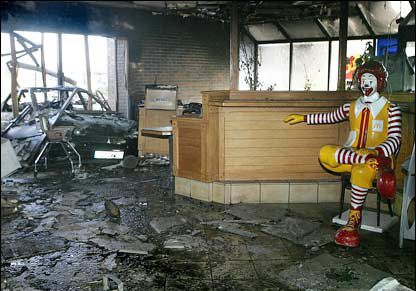
In one of his perspicacious articles on the French riots, Lenin brings up an old chestnut on the ‘alienating’ effect of post-war architecture; on the remnants of the utopianism of Le Corbusier, and their becoming a setting for class warfare rather than the harmonious community theorists envisaged. This comes soon after the start of the demolition of the Aylesbury Estate in South London, which had the curious honour of being Europe’s largest housing scheme, in favour of low rise and presumably yellow-brick blocks. There are a few questions here though- if high rises are inherently unconducive to community, why are the cities of East Asia not hotbeds of anomie and unrest? If these housing schemes inherently create ghettos, then why is it so expensive to live in the Barbican or the Trellick Tower? And aside from this, surely there’s nothing less atomised than a community in revolt, in the rioters united against the police? But this isn’t to say that there’s not a great deal of truth in this critique.
Lenin’s piece is reminiscent of Jonathan Raban’s proto-punk urbanism in The Soft City, which attacked these theories back when they were still the orthodoxy of urban planners. The arguments are all rehearsed here- first of all, the planners are anti-urban, obsessively rationalist- a schematism ‘where a handful of watercolour humans, tapering from the shoulders down, flit their spidery way through an architecture so simple and gigantic that they cannot corrupt it.’ Along with this comes an argument, surprising when heard from socialists, that this attacks commerce, the high street. The post-war international style completed an ideological circuit from visionary collectivism to capitalist technocracy, writ large in the formidable featurelessness of the World Trade Center. In a 2003 piece in Area, Marshall Berman contrasts this top-down idealism with the direct democracy of the Athenian agora- ‘the WTC was an example of the kind of urbanism that tried to clear away the street…what they wanted was to clear the city of what Rudy Giuliani used to call ‘the pedestrian glut’’ Meanwhile, authentic democracy is shabby, unkempt, disordered… ‘Plato and Aristotle couldn’t stand it, but this is where the poets appeared and the politicians gave their speeches…both Plato and Aristotle had plans to break up the agora, as did the anonymous writer known as the Old Oligarch, who scandalised the agora, and said ‘you can’t tell the masters from the slaves.’ Everybody alike, all sloppy’
The Estates Stick up like Stacks
Even when their houses are whitewashed, the sky will be dark; devoid of joy they will tend to drink for excitement; they will go on deteriorating; and as to their children, the more of them grow up to manhood, the lower will be the average physique and the average morality of the coming generation.
Alfred Marshall, The Housing of the London Poor, 1884

At some point, a fusion of Utopianism and Marxism- let’s not forget that one of the Bauhaus’ aims was adapting William Morris’ theories for mass production- curdled, perhaps at some point in the 1950s- suddenly business wanted in; Nazi sympathiser and pioneer of architectural postmodernism Philip Johnson would sneer at functionalists who wanted to provide for ‘some proletarian superman of the future’. A thesis could be written about the failure of post-war planners to deliver the promised Radiant City. In Britain it could be dated from the defeat of Nye Bevan’s housing plans in the 1945 government. Bevan was always incredibly scathing about the tendencies of capitalist building towards the twee and the kitsch- he promised to wipe the slate clean after the 1930s’ ‘marzipan period’ and its ‘silly little bungalows’- as with Attlee’s slogan that ‘nothing is too good for the working man.’ After Bevan was replaced by the more pliant Hugh Dalton, British development would pivot on an uneasy dialectic between dystopian modernism and obscurantist new towns.

Despite this, the 1950s-70s’ ‘cities in the sky’ are in the first decade of the 21st century, along with Bevan’s NHS, the most visible remnants of British Socialism- one is still enormously popular, so much so that Thatcher and Blair’s attacks on it have to be veiled in fulsome tributes; the other something of an embarrassment. Michael Collins’ contrarian ‘biography’ of the English Working Class depicts the kitsch embellishments people would make to their flats on the Elephant and Castle as micro-resistances- ‘….instead of living behind the same cobalt-coloured door as all their neighbours, they were choosing their own, and maybe adding a pane of glass with a rain effect and a brass doorknob’. I’ve lived in a couple of what, with insight into their transient, experimental nature, Americans call ‘projects’ and Scots call ‘schemes’. One was the ‘Flower Estate’ (all the roads named after flowers!), built in the 1930s, on the edge of the city of Southampton. People had their own gardens. A few had timbers stuck here and there. It was overwhelmingly white, had a large skinhead contingent, and was the most psychotically violent place I’ve ever lived -including Brixton, for the record. The other was Northam Estate, a flagship development next to the by then barely used docks, built in the early 60s- singled out for special praise for its rationality and order by Nikolaus Pevsner. It was all there, the pointless patches of grass, the windswept precincts and signifiers for urban anomie. It’s quite friendly.
Collapsing New People
Architecture is the weakest of the arts, in so far as it is the most dependent on the collective sensibility of the period…if the world would only build temples to machinery in the abstract then everything would be perfect.
Wyndham Lewis, The Caliph’s Design, 1919

There is another afterlife to these structures, one shown by the success of Martin Parr’s Boring Postcards, or the belated campaign to save Portsmouth’s Tricorn Centre, which runs parallel to the revaluation of Penguin paperback designs, or of the BBC Radiophonic Workshop; a savouring of their futurism and optimism, their refusal of the customary English torpor. Nostalgia against Nostalgia. The ‘left-wing melancholy’ behind such a project of conservation was most poignant on 1471’s ‘Arndale Britain Revisited’, in which the original sites were usually privatised, or had become shopping centres, or in some way lost their original otherness. England came back from it’s post-war retreat in the 1980s, with Prince Charles as its architectural night in shining armour, in glorious victory against ‘Britain seen as a building, forward looking country, a country that still had faith in progress….’ ‘These were postcards, not of past glories, of statues and monuments, but of a modern, progressive Britain, of motorways, technical colleges and holiday camps. The postcards span a period, at my best guess, roughly 1955 to 1978. An England dead and gone.’

I was pleased when reading The Soft City to find that a typical Radiant City was, in fact, about a mile or two up the road from where I was born- in the Millbrook district of Southampton, described by Raban as ‘a vast, cheap storage unit for nearly 20,000 people. Laid out on a sloping plain, it has 50 acres of grassland at its centre, a great, useless balding green space of sickly turf and purely symbolic value. What one sees at first are the tower blocks, 24 storeys high, of pre-stressed concrete and glass, known, I am told, as ‘slab block/scissors type’ should anyone want to order more. The roads are service roads- they loop purposelessly around the estate in broad curves that conform to no contours. There is no street life in them…the stay at home mother in a tower-block flat can be as alone as an astronaut marooned in space: indeed, the sociological space in which she moves is almost as uncharted.’ Even in the late 90s, this desolation hadn’t lessened any- though the most feared area was in fact the low-rise 80s red-brick cul de sacs nearer the centre, which lumbered under the wonderfully 80s Labour Council name of Mandela Way. 1981, or Broadwater Farm, or the Paris Banlieue today, would partially give the lie to his last point- ‘tower block planning, by driving people into disconnected private cells, reliably insures against insurrections. Bad neighbours make for a certain kind of social security; Millbrook breeds vandals, but not revolutionaries.’- and rioters are usually somewhere between the two. But there is an undeniable ring of truth to the claim that ‘we should not fall for the assumption that utopias are usually the work of optimists. Far more often they are thinly veiled cries of rage and disappointment.’ These developments, even to their aficionados, are defined mainly by their failure. Perhaps it’s here that I should declare again a personal interest…
Everyone on Park Hill came in Unison at Four Thirteen AM

All cities are geological. You can’t take three steps without encountering ghosts bearing all the prestige of their legends. We move within a closed landscape whose landmarks constantly draw us back to the past. Certain shifting angles, certain receding perspectives, allow us to glimpse original conceptions of space, but this vision remains fragmentary.
In Chirico’s paintings (during his arcade period) an empty space creates a richly filled time.
Ivan Chtcheglov, ‘Formulary for a New Urbanism’, Internationale Situationniste 1, 1958

In Southampton in the late 1990s, there was very obviously a war going on, and our side was losing. We would walk along Western Esplanade in torrential rain, where on one side two psuedo-Mies blocks were wrapped in plastic like Laura Palmer, readied for their imminent detonation; on the other side, a vast ‘leisure complex’ was under construction, filling in the spaces left by the city’s industry, still not recovered from the blow inflicted on it by Heathrow. This huge development would take over the entire Western half of the City Centre; in a significant irony, at the same time the redevelopment of the residential inner city, St Mary’s, was being botched, riven with backhanders and corporate favours- eventually it would be chopped to pieces in a manner that Robert Moses would be proud of. (this little episode is recounted in George Monbiot’s Captive State). In 1997, this process was only underway, and the city could still be reimagined- the twee arches, the faux-limestone, the endless shopping centres could be pretended away by concentrating on the clean lines, the ferocious concrete, the sheer despotic size of developments like Millbrook, or the pugnacious 20 storey tower block Shirley Towers, like a middle finger stuck up at the squat Victoriana and Mock Tudor of SO15. The delight when the brutalist flats by the Central Station were listed, in the teeth of opposition from the City Council and local press.

The record that obsessed us at the time was on Pulp’s 1993 Intro, a 10 minute fantasia called ‘Sheffield: Sex City’, in which every contour and line of the post-industrial city is infused with eroticism- opening with a list of Sheffield suburbs intoned with sublime sensual relish, and eventually coming to a climax of utopian urbanist carnality, as ‘everyone on Park Hill came in unison at 4.13am, and the whole block fell down’. Park Hill, with its endless walkways and Constructivist/Brutalist intersections and permutations, exemplifies the truly visionary potentialities of the post-war moment perhaps better than any other structure, it’s vaulting over-ambitiousness almost ensuring that it’s inhabitants never had to touch the ground. To sexualise such a structure isn’t much of a rhetorical leap-one thinks of the geometries of Ballard’s Atrocity Exhibition, in which the intersection of two walls is as erotic as that of two legs. A slight reimagining of the remnants of the past and you have an incredible commingling of space, sexuality and socialism.

By the mere act of walking we were perpetuating some kind of offence against Southampton- the new order would be totally impenetrable to the pedestrian. The structures which would, by the end of the century, become ‘West Quay’, ‘Western Esplanade Shopping Park’ and ‘Leisure World’ were the revenge of the suburbia of Hampshire and its Cars against the persistently Labour-voting City in its midst, and they killed it stone dead. In 1959 Guy Debord wrote in Internationale Situationniste that ‘the breaking up of the dialectic of the human milieu in favour of automobiles masks its irrationality under psuedopractical justifications. But it is practically necessary only in the context of a specific social set-up. Those who believe that the particulars of the problem are permanent want in fact to believe in the permanence of the present society’. The reconquest of the city and the architecture that accompanies it attempt to abolish lived time, to do away with history, as can be seen by the pallid historical eclecticism of the buildings that encase the shops and leisure facilities. Just round the corner from West Quay’s looming frontage is its car park, tucked in behind medieval walls, though totally visible to pedestrians (who are of course irrelevant). Here, bizarrely, functionalism survives- a shell of minimalist concrete contours, with no attempt at gloss or decoration- the not so hidden reverse.
posted by owen hatherley # 9:48 AM 
Comments:
<< Home
you really are the blog-world's answer to Patrick Keiller!
Did you see this article from today on plattenbauen in East Germany? Curious to know whether you think this is a good/interesting idea in the wake of your ambiguous "dialectics of the towerblock"...
Must admit to having a rather under-developed relation to the specific architectural questions - council housing in the country tends towards the bungalow splurge, with obvious lack of space constraints the order of the day...and limited revolutionary potential there - no polis! (unless "politics" involves animals of course - foot and mouth, beef, foxes, etc). But it doesn't.
So it's this point I appreciate most:
the revaluation of Penguin paperback designs, or of the BBC Radiophonic Workshop; a savouring of their futurism and optimism, their refusal of the customary English torpor. Nostalgia against Nostalgia
The particularity of an insanely English kind of futurism - not so much Bugattis, fascism and explosions as glitches, mixed colour/geometry experimentation and a quiet order (imagine all the informative blue Penguin paperbacks in a line, the green crime series stretched out on a shelf, the orange fiction collection piled up in its entirity...).
There's a real lack of "logos" (the design-type, not the reason-type!) in this Brit-Nostalgia I think - no strong commie symbols, for example. Just odd little things (the book Penguin itself - and the Puffin - I adore my Puffin Club member's badge!)...what do you think? Seems like we talk of specific examples/places instead - the newer Coventry cathedral, the Trellick Tower as you mentioned, etc. What are the symbols of a particularly British nostalgia - based around the more "transient" fashion, music...? Or the more specific, maybe: housing plans, street names, shops, pubs, clubs....?
Did you see this article from today on plattenbauen in East Germany? Curious to know whether you think this is a good/interesting idea in the wake of your ambiguous "dialectics of the towerblock"...
Must admit to having a rather under-developed relation to the specific architectural questions - council housing in the country tends towards the bungalow splurge, with obvious lack of space constraints the order of the day...and limited revolutionary potential there - no polis! (unless "politics" involves animals of course - foot and mouth, beef, foxes, etc). But it doesn't.
So it's this point I appreciate most:
the revaluation of Penguin paperback designs, or of the BBC Radiophonic Workshop; a savouring of their futurism and optimism, their refusal of the customary English torpor. Nostalgia against Nostalgia
The particularity of an insanely English kind of futurism - not so much Bugattis, fascism and explosions as glitches, mixed colour/geometry experimentation and a quiet order (imagine all the informative blue Penguin paperbacks in a line, the green crime series stretched out on a shelf, the orange fiction collection piled up in its entirity...).
There's a real lack of "logos" (the design-type, not the reason-type!) in this Brit-Nostalgia I think - no strong commie symbols, for example. Just odd little things (the book Penguin itself - and the Puffin - I adore my Puffin Club member's badge!)...what do you think? Seems like we talk of specific examples/places instead - the newer Coventry cathedral, the Trellick Tower as you mentioned, etc. What are the symbols of a particularly British nostalgia - based around the more "transient" fashion, music...? Or the more specific, maybe: housing plans, street names, shops, pubs, clubs....?

ta....the plattenbauen thing is kinda intriguing--marzahn, where they're doing this, is an extremely odd place (which is why i posted this pic- http://themeasurestaken.blogspot.com/2005/05/marzahn.html ) and this idea seems to actually accentuate the oddness- the buildings actually look more corbusier-esque when cut down and chopped up...though i do find the sheer size of blocks rather alluring i must admit.
the english futurism thing is very under-investigated- there were a few words about it on blissblog recently- http://blissout.blogspot.com/2005_11_01_blissout_archive.html#113099102635719257 where i think he rather overdoes the paternalism angle- but there's a similar kind of heath-robinson thing to the music he talks about, sort of childlike and jarringly modern at once, which obv applies to the penguin covers...
it doesn't really have recognisable symbols i agree, but specific sounds or architectural features evoke it. the quietness is important too- futurism that doesn't bang you over the head, though there's always a dialectic between cute and brutal in this (i suppose you could call it a) tradition...will write more soon possibly...
the english futurism thing is very under-investigated- there were a few words about it on blissblog recently- http://blissout.blogspot.com/2005_11_01_blissout_archive.html#113099102635719257 where i think he rather overdoes the paternalism angle- but there's a similar kind of heath-robinson thing to the music he talks about, sort of childlike and jarringly modern at once, which obv applies to the penguin covers...
it doesn't really have recognisable symbols i agree, but specific sounds or architectural features evoke it. the quietness is important too- futurism that doesn't bang you over the head, though there's always a dialectic between cute and brutal in this (i suppose you could call it a) tradition...will write more soon possibly...
Think you are right to say that this odd "British Futurism" is evoked by specific sounds/architectural features, rather than agressively manifested by them...rather than speed/noise/distaste for biology we have, for example, sweet bi-coloured stamps celebrating various industries, occupations, the NHS and "Europa". Tony Benn as Postmaster General issued this marvellous statement regarding how stamps should appear in the 1960s: "to celebrate events of national importance...to reflect the British contribution to world affairs, including the arts and sciences and to extend public patronage to the arts by encouraging the development of miniscule art."
British futurism as miniscule art?
There are 13 results for "British Futurism" but really nothing of any content, though the first piece about the West Coast Main Line is pretty interesting. Ha! Have just realised who it's by...have a look. Includes the ridiculously splendid phrase "grinning sheeple".
I think it's a genre well worth pursuing, however slight and artificially constructed it might turn out to be. What do you think about Alice and Peter Smithson and the 1956 "This is Tomorrow" exhibition? Though, actually, perhaps this is too late...too American, popist, knowing. The decision to build Coventry Cathedral anew was taken, afterall, the morning after it had been destroyed in 1940...
That blue/green that Penguin used for its informational books, which also turns up on the stamps of the '60s is the true shade of British futurism to me - where do we see it now I wonder....
British futurism as miniscule art?
There are 13 results for "British Futurism" but really nothing of any content, though the first piece about the West Coast Main Line is pretty interesting. Ha! Have just realised who it's by...have a look. Includes the ridiculously splendid phrase "grinning sheeple".
I think it's a genre well worth pursuing, however slight and artificially constructed it might turn out to be. What do you think about Alice and Peter Smithson and the 1956 "This is Tomorrow" exhibition? Though, actually, perhaps this is too late...too American, popist, knowing. The decision to build Coventry Cathedral anew was taken, afterall, the morning after it had been destroyed in 1940...
That blue/green that Penguin used for its informational books, which also turns up on the stamps of the '60s is the true shade of British futurism to me - where do we see it now I wonder....
a quick one, as i'm off home soonish, but carmody is very much the don of this sort of stuff- way before the radiophonic stuff got reissued he wrote this semi-legendary piece, which defines the terms of 'british futurism' (let's come up with an acronym here! BrFu, or britfut or something similarly Festival of Britain..
anyway this is the piece- Structures and New Worlds
Post a Comment
anyway this is the piece- Structures and New Worlds
<< Home
Archives
May 2005 June 2005 July 2005 August 2005 September 2005 October 2005 November 2005 December 2005 January 2006 March 2006 April 2006 May 2006 June 2006 August 2006 September 2006 November 2006 February 2007 April 2007 May 2007 August 2007 November 2007 February 2008 June 2008 November 2008 January 2009 May 2009 June 2009 November 2009
did you agree to the measures taken?also
- Archinect
- Audacity
- Blueprint
- Building Design
- Frieze
- Historical Materialism
- MONU
- New Humanist
- New Statesman
- Nothing to See Here
- Perforations
- Socialist Review
- Socialist Worker
- The Weblog
- Wikipedia
- The Wire
- Ads Without Products
- Aloof From Inspiration
- Beyond the Implode
- Beyond Beyond the Implode
- Blissblog
- Degradation Ceremony
- End Times
- Entschwindet und Vergeht
- Fantastic Journal
- I Like
- The Impostume
- Infinite Thought
- Institute for Conjunctural Research
- Homo Ludens
- Kosmograd
- K-Punk
- Lenin's Tomb
- The Mire
- No Useless Leniency
- Poetix
- Screened Out
- Sea Songs
- Socialism and/or Barbarism
- Things Magazine
- Voyou Desoeuvre
- We Are Bad
- The Twentieth Century Society
- City of Sound
- The Sesquipedalist
- The Joy of Concrete
- no2self
- Architecture in Berlin
- City of Sound
- Entschwindet, das CV
- Dismantled King is Off the Throne
- SuperSpatial
- (what is this)
- Progressive Reactionary
- Russian Utopia Depository
- Maraid Design
- Sevensixfive
- Varnelis
- Architechnophilia
- Slab
- Part IV
- Strange Harvest
- Atelier A&D
- Archislave
- Candyland
- Flickr Brutalism
- From Here to Modernity
- Skyscraper City
- Monuments of the Future
- Archigram
- Chernikov Virtual Museum
- Chernikov Archive
- Gabion
- 0lll
- Shicklerart
- Constructivism in Arhitecture
- Unmitigated England
- YouTube Meades Shrine
- Enchanted Isle
- Boredom is always Counter-Revolutionary
- Antiflaneur
- Cracks in the Fabric
- Mapping Melbourne
- BLDGBLOG
- Lumpen Orientalism
- English Heretic
- Sub-Urban
- Punk Planning
- Subterranea Brittanica
- Diary of a Bluestocking
- Life without Buildings
- The Box Tank
- Condencity
- Nobody There
- Subtopia
- Metropolis
- aggregat4/5/6
- Architectures of Control
- The London Particular
- Ritual Landscape
- Dancing Bears
- Charles Holden
- London Destruction
- Derelict London
- Greenwich Phantom
- Classic Cafes
- London belongs to Me
- Transpontine
- Londonist
- Straight Outta Clapton
- London Transport Poster Archive
- Plakaty.Ru
- Revolution by Design
- Russian Poster
- Flickr USSR Posters
- Stefan Landsberger's Chinese Propaganda Poster Pages
- Russian Civil War Posters
- Stenberg Brothers
- Soviet Poster A Day
- The Poster Prop Page
- Russian Posters at allposters
- Militant Esthetix
- Savage Messiah
- Click Opera
- Snegourotchka
- New Plastic Ideas
- Modern Missives
- The Beasthouse
- Eurhythmania
- Petite Sophist
- Missing Dust Jacket
- Au carrefour étrange
- Triangular Sun
- Paperpools
- Feast of Palmer
- Cinders and Dust
- American Stranger
- Culturemonkey
- Enthusiasm
- Tom Roper's Weblog
- And you may find yourself...
- Rabbits, Toyen and so forth
- Grammar Police
- The Stomach Room
- Whore Cull
- Cigarette Smoking Blog
- Carceraglio
- David Byrne's Blog
- A Personal Miscellany
- &so this is christmas
- Taylor Parkes' Alternatives to Suicide
- smokewriting
- Cultural Parody Centre
- Tangerines in a Red Net Bag
- St Blaize
- Altering Labyrinth
- Colour of Memory
- Mountain7
- Chained to the Cinematheque
- Elusive Lucidity
- Faster than Instant Noodles
- Kino Slang
- Kinoblog
- Greencine Daily
- Senses of Cinema
- Girish
- Bright Lights after Dark
- Sphaleotas
- In The Realm of the Senses
- Raccoon: Notes and Scavengings
- Supposed Aura
- Roger Ebert
- Notes on Rhetoric
- Limited, Inc
- The Pinocchio Theory
- An und Für Sich
- Object-Oriented Philosophy
- Splintering Bone Ashes
- The Immeasurable Excess
- Bourgeois Sociology
- Jane Dark's Sugarhigh!
- Museum of Doubt
- Almost not There
- Planomenology
- Varieties of Unreligious Experience
- Random Variable
- Radical Philosophy
- Red Thread(s)
- Limited Language
- Lapsed Modernist
- Irrational Numbers
- Walter Benjamin Research Syndicate
- Long Sunday
- Metastable Equilibrium
- Larval Subjects
- Radio Free Narnia
- Hyperstition
- Reading the Maps
- Parole
- Herbert Marcuse Online
- Citta Violenta
- Ballardian
- Barbaric Document
- M John Harrison
- Mayakovsky and his Circle
- Troglodytes Troglodytes
- B.S Johnson
- Sir Percy
- heronbore
- interrupted transmission
- The Far Queue
- The Invaluable Marxists.org
- Chto Delat?
- Chto Delat Blog
- A Gringo in the Bolivarian Republic
- Marx and the Financial Crisis
- Radical Perspectives on the Crisis
- Little Red's Resolution Trust
- Mute
- Encyclopaedia of Decency
- Unstrung
- Louis Proyect, Unrepentant Marxist
- Iron Curtain Call
- Adventures in Historical Materialism
- Situationist International Online
- The Soul of Man Under Capitalism
- Speak You're Branes
- The Music of Weapons
- 3arabawy
- Virtual Stoa
- Green Galloway
- Further Left
- Counterpunch
- Dreaming Neon Black
- General, Your Tank is a Powerful Vehicle
- The Curmudgeonly
- Complex System of Pipes
- Apostate Windbag
- Progressive Gold
- Jews sans frontieres
- Somedisco
- Kotaji
- Qlipoth
- Praxis
- Bctzoiwp
- John Molyneux
- What in the Hell
- Le Colonel Chabert
- A Very Public Sociologist
- Through the Scary Door
- pas-au-dela
- Trinketization
- Law and Disorder
- Houzan Mahmoud
- Post-politics in Depth
- Mentasms
- Fangirl (archives)
- Skykicking
- Attic Plan
- Airport through the Trees
- Monster Bobby
- Run Away Home
- Quietus
- History is Made at Night
- The Blue In The Air
- Pop Life
- Uncarved
- Four Four
- Pop Feminist
- The Drexciya Research Lab
- Mapsadaisical
- Woebot
- Sasha Frere-Jones
- The Original Soundtrack
- House is a Feeling
- Popjustice
- Quiet Talks and Summer Walks
- Dissensus
- Blogglebum Cage
- Euro Like Me
- Backhaus
- Enthusiastic but Mediocre
- Goodnight London
- Dirrrty Pop
- Philip Sherburne
- FURTHER MISÅDVENTURES beneath the ÜNDERFELT of NØISE
- The Rambler
- Gutterbreakz
- Kid Shirt
- Trunk
- Kraftwerk
- Delia Derbyshire
- Fluxblog
- We are IE
- an idiot's guide to dreaming
- Blackdown
- polystyle desu
- Deeptime
- Ripley
- Les Temps Modernes
Dies sind die besten
bauen
raum
die große Warze
plakat
Ästhetik
kino
denken
poetik
Politik, Geschichte
musik non-stop
