The Measures Taken
A defunct site housing papers, articles and lengthier disquisitions by Owen Hatherley, now blogging only at Sit down man, you're a bloody tragedy.Thursday, May 18, 2006
Another effort, Britons, if you would be Modernists
Modernism- NFT and V&A, London
Two- Carrying out the General Line

‘The machine, so far the subservient agent of uncreative exploitation, becomes a constructive element in a new living organism.
Only through a drive for effectiveness can we master our unrest, only at top speed will we master our haste. Then will the spinning world stand still.’
Erich Mendelsohn, 1919
Heading the first Bauhaus manifesto is a woodcut by Lionel Feininger. It shows an abstracted, jagged medieval building, seemingly explosive with power and light. A copy of this woodcut is in a glass cabinet in this museum in South Kensington, labelled ‘Cathedral’- leaving out, oddly enough, the rest of the title- ‘of Socialism’.

The V&A exhibition opens with designs that try to fill the space opened by two political ruptures. Or two months- October 1917 in Russia and November 1918 in Germany. And while in the former there was a ‘victory’ and in the latter a defeat, this is only really obvious in retrospect. There are two real artistic outgrowths of November. First of all that of Berlin Dada, whose splenetic political satire and physical abjection parallel modernism in the use of montage and new technology but are somehow more sloppy- focused on ridicule and expose of the bourgeoisie and its social democratic lackeys rather than suggesting what should fill their spaces once removed. The other, and less famous, artistic response to November is that of the collective Arbeitsrat fur Kunst. Roughly translated this name means ‘Working Soviet for Art’- the ‘rat’ being a reference to the ‘rate’, councils or Soviets, a form of direct democracy that replaced parliament in Russia and threatened to do so in Germany. ‘All Power to the Soviets’ was the slogan of October, and the period of 1918-23 saw the emergence of short-lived (from a week to nine months) ‘Ratesrepublik’ in Hungary, Slovakia, Finland and Bavaria- a British government report was made in 1919 on the fact that Soviets had sprung up in Slough. The Bavarian Soviet Republic was briefly led by Ernst Toller, an Expressionist playwright (and had in its rank the future Douglas Sirk) and the Arbeitsrat and the similar Novembergruppe were made up mainly from painters, designers and architects associated with Der Sturm or Die Brucke; Expressionists all, concerned with fierce, jagged lines and unleashed subjectivity.

So what, then, did the products of this Working Soviet for Art look like? Well- rather pretty. Fairy tale cities with a hint of science fiction. The leader of the Arbeitsrat fur Kunst, along with Walter Gropius himself, was the architect Bruno Taut. Taut’s work at the time was fixated first on the possibilities of glass- he had already designed and built a glass house in 1914- but also on a kind of resurrection of an idea of the medieval community put into the service of socialism. The city designs Taut produced at this point (a few of which are on show) seem like settings for some millenarian community of the 16th century, that of Thomas Munzer or the Movement of the Free Spirit, bent on achieving the kingdom of heaven on earth. One source for the shimmering cities of Taut or Hans Scharoun was in the science fiction of the author Paul Scheerbart- imagine a parallel universe in which HG Wells was the touchstone for an architectural school. Taut’s images of a socialist Schlaraffenland remind one that Ernst Bloch (whose 1918 Spirit of Utopia is utterly key to this movement) had read a political utopianism into fairytale depictions of impossible transformations. The other ingredient of this period was a kind of warped version of Christian Socialism- here stripped of any religious specificity but burning with a ferocious, if utterly vague, ‘spirituality’.

The writings of Ludwig Meidner from this time show this particularly strikingly. Meidner had a combination of Jewish Messianism and Mystical Marxism that sometimes anticipates Walter Benjamin’s later synthesis. Meidner’s paintings of the 1910s are a succession of apocalypses and worlds being overturned, engulfed in flames. He was an evangelical adherent of the Arbeitsrat, writing ‘we artists and poets should be in the forefront of struggle. There had to be an end to exploiters and exploited. We must decide in favour of the socialisation of the means of production so that everybody should have work, leisure, bread, a home and an intimation of higher goals. Socialism should be our new faith.’ Meidner and his fellow Expressionists had been enthusiastic Nietzscheans before, concerned with only the release of their own suppressed subjectivity, their status as artists as marking them as superior creatures- and here they were offering their services to a proletarian revolution. There is a similar reaction here though to the gap left by the end of organised religion- a communism that takes its precepts from religion at its most direct, that harnesses the religious impulse for the worldly. There is a space in the Arbeitsrat for the machine and the mechanistic, but a subordinate one. More prophetic was Erich Mendelsohn, whose Einstein Tower is perhaps the only surviving monument of this period. Mendelsohn achieves curious, ‘living’ forms (‘organic!’ said Einstein on first seeing his tower) by the determined employment of technology. The Arbeitsrat had one major exhibition- in Berlin in 1920, of designs, paintings and sculpture by professionals, amateurs and children, with none of the work attributed- then dissolved itself.
‘The combination of the Russian revolutionary sweep with American efficency is the essence of Leninism in Party and state work.’
Joseph Stalin, ‘Foundations of Leninism’, 1924

Ten years later and Scharoun, Taut and Gropius have all built their ideal communities- bereft of the angular medievalism they had promised, instead austere, streamlined, functional, technocratic. The absent mediator here is Americanism, the obsession first with the popular culture of the USA- jazz, skyscrapers, Chaplin- but also in the technocratic ‘efficiency’ of Taylorism and Fordism, and this technocracy is perilously close to bureaucracy. The lecture of Stalin’s quoted above was given to a new generation of Soviet technocrats, increasingly aware of their power. But artistically, while there had been a progression from religiosity to technocracy, this was with no lessening of the utopian and socialist bent of the aftermath of the revolutions. Looking at many of the films shown by the NFT and in clips at the V&A one can see that the same preoccupations- ideal communities, a mingling of the machine and the animal, a reaching towards the impossible with a disavowed bureaucratic underside- are there, only rationalised, freed of their remaining looks back to the past. This can be seen most strangely in two of these films made in the USSR- Eisenstein’s least commented on film The General Line and Dziga Vertov’s Enthusiasm, both of which take the technocratic impulse that had infused the utopians to bizarre conclusions, incredible minglings of earth and metal.

There is a more innocent (if sardonic) version of these questions also on show- Protazanov’s Aelita, marked by the geometric eroticism of Alexandra Exter’s costume designs, offering a cocktail of sex, interstellar sci-fi and insurrection. Far from the grim rural setting of The General Line- one of the genre of ‘boy (or in this case, girl) meets tractor’ that was so dominant in Soviet filmmaking at the turn of the 1930s. The film uses a delirious amount of cutting and dream-sequences to violently threaten the age-old drudgery depicted in the film’s early stages. Essentially the film depicts the struggle of a peasant woman, Marfa, to mechanise and collectivise her village- which just happened to be the general line of the Party at this point (which caused near-civil war, which we’ll come to). There are certain set-pieces that give the lie completely to the equation of modernism as antiseptic, hostile to the subconscious and sexuality. Eisenstein does this most famously in the cream separator sequence (Kenneth Anger’s favourite) where the new technology achieves a kind of communal sexual consummation, showering the shocked peasants in cream, cut to the ecstatic face of his heroine, reaching out and touching the warm jets as they shoot from the machine. Pointedly, this sequence follows one of religious obscurantism, where the villagers march in procession and hope for miracles. Eisenstein shows communism and technology as the fulfilment of religion- here are the miracles, in the cathedral of socialism.

The ‘mobilisation of the land’ that Corbusier’s Ville Radieuse (which was in fact a ‘response to Moscow’ of 1930- an offer of his services for the Five Year Plan, contemporary with his vast Centrosoyus building in the Soviet capital) promised is all over The General Line, in particular in Marfa’s dream sequence. This is perhaps one of cinema’s only paeans to factory farming, as well as an architectural fantasy. Her dream is a depiction of a collective farm housed in a handsome Corbusier-esque building mocked-up by Andrei Burov (which curiously looks a little like Maxwell Fry’s Hampstead Sun House), all chicks in little bags, line upon line of milk in glass bottles, the higgledy-piggledy of the actual farm effaced by cleanliness and geometry. The actual built architecture of the period is edited in as symbol of technologised socialism- Eisenstein shows Serafimov’s vast Constructivist complex at Kharkov and Zoltovsky’s power station in Moscow in a sequence where Marfa is aided by ‘the workers’, in this case a band of urbanites rallying round her demand for a tractor. This is the myth of the Five Year Plans in essence- a spontaneous response of the workers to the needs of the countryside, only occasionally encumbered by the bureaucracy.

Ah, the bureaucracy. Because, alas, the Soviet Union was by this point only very dubiously ruled by Soviets. The bureaucracy were at this point (1928-32) fairly clearly a ruling class- the Stalinists showing themselves unexpectedly good Hegelians by awarding such a prominent role to the ‘universal class’- but for all that, they get a hard time in the films of the period. In Kozintsev & Trauberg’s wonderful Odna, they co-operate with the kulaks in the attempted murder of a young female teacher who has been posted to a rural school, hiding their class collaboration behind revolutionary rhetoric. This is parallelled in The General Line. Marfa and her proletarian helpers visit a government office, finding its cheroot-smoking inhabitants elegant and indolent, the lovingly shot machinery of the stenographers merely ineffectual- the effect of their initial refusal of the tractor application is shown, the hard physical drudgery of the harvest.

Initially obstructive and patrician, the bureaucracy are shamed into action by the worker- Eisenstein montages explosions into his outraged shout of ‘carry out the general line!’ Suddenly, shocked, they spring into life, sparking off activity, a mechanical chain leading to- oh yes- a gleaming new tractor. The odd half-honesty of this may have been one of the factors that worried Stalin so much about the film- he ordered several re-edits and a change of title to The Old and the New, diassociating it from party policy- but it is more ideological than that. The bureaucracy is a class that disavows its own existence and its own methods- here Eisenstein depicts the bureaucracy obstructing what was of course the bureaucracy’s own policy (the collectivisation of agriculture), one which massively extended its own power, and which led to famine and massacre on a huge scale.

In Dziga Vertov’s 1929 documentary Man with a Movie Camera the bureaucracy are similarly mocked, but a wholly absent from the follow-up, the ‘Industrial Symphony’ Enthusiasm , a hymn to the Five Year Plan, filming the industrialisation of an area of the Ukraine. The film is remarkable first of all for its sound design, the extreme innovation of which was parallelled at the time- for instance Shostakovich’s collages for Odna, using radio static, public address systems and theremins along with his own compositions, here in short stabs, commenting dialectically on rather than soundtracking the action. Sometimes when the characters speak we hear their voices- sometimes there are intertitles, giving a shock effect to the interjection of the voice. Vertov takes this to astonishing extremes, creating a montage that pre-empts Pierre Schaeffer and musique concrete by nearly 15 years, manipulating and montaging industrial clangs and feedback scrapes into a brutal, colossal composite of lumbering power.

Compared with the earlier film this is almost painfully slow, replacing its effervescence with a pounding, sluggish gait- every movement is shown as a struggle, as an achievement. The mingling of man and machine is here dirty, rough, and overtly sexual, all penetrating pistons and spilling fluids- here, pulsating, is Mendelsohn’s new living organism. And here too is the rejection and revival of religiosity. The film opens with the destruction of churches, crowds cheering at the dismantlement and mockery of the Orthodox Church. And later we see a group of young women shock-workers, beautiful and mechanistic with their thick, tension filled bodies- all chanting avowals of how much they will produce, like a kind of industrial liturgy. Stakhanovites as the Elect. Again and again we hear of the determination to fulfil the Five Year Plan in four years- ‘2+2=5’, as the slogan went. This obsession with targets, with fulfilling impossible quotas is stripped of its utopianism but is still very much present in today’s Market Stalinism, along with the disavowal of its own existence. The bureaucracy are the hidden force behind all that we see in Enthusiasm, the absent centre, directing all, issuing edicts increasingly out of touch with reality.

By the time the Five Year Plan had ended in the early 30s, films like these were literally illegal to produce, with Eisenstein’s techno-pastoral and Vertov’s ‘film-truth’ (suspiciously using actual footage) equally dubious to the consolidated bureaucracy. But in these films there is a grandiose consummation of the artist-soviet’s exultation of machine romanticism, socialism as new faith—what is absent is the ‘Soviet’ itself, ie the radical democracy that accompanied the early years of both revolutions, enabling the films to become the oblique self-portraits of a new ruling class. But running through them like electricity is the headiness of an actual revolution, a paradox Zizek describes as the ‘radical ambguity of Stalinism’. And it’s this, sitting so wonderfully incongrous in South Kensington, that we would imagine makes Simon Jenkins and his ilk so uncomfortable.
Two- Carrying out the General Line

‘The machine, so far the subservient agent of uncreative exploitation, becomes a constructive element in a new living organism.
Only through a drive for effectiveness can we master our unrest, only at top speed will we master our haste. Then will the spinning world stand still.’
Erich Mendelsohn, 1919
Heading the first Bauhaus manifesto is a woodcut by Lionel Feininger. It shows an abstracted, jagged medieval building, seemingly explosive with power and light. A copy of this woodcut is in a glass cabinet in this museum in South Kensington, labelled ‘Cathedral’- leaving out, oddly enough, the rest of the title- ‘of Socialism’.
The V&A exhibition opens with designs that try to fill the space opened by two political ruptures. Or two months- October 1917 in Russia and November 1918 in Germany. And while in the former there was a ‘victory’ and in the latter a defeat, this is only really obvious in retrospect. There are two real artistic outgrowths of November. First of all that of Berlin Dada, whose splenetic political satire and physical abjection parallel modernism in the use of montage and new technology but are somehow more sloppy- focused on ridicule and expose of the bourgeoisie and its social democratic lackeys rather than suggesting what should fill their spaces once removed. The other, and less famous, artistic response to November is that of the collective Arbeitsrat fur Kunst. Roughly translated this name means ‘Working Soviet for Art’- the ‘rat’ being a reference to the ‘rate’, councils or Soviets, a form of direct democracy that replaced parliament in Russia and threatened to do so in Germany. ‘All Power to the Soviets’ was the slogan of October, and the period of 1918-23 saw the emergence of short-lived (from a week to nine months) ‘Ratesrepublik’ in Hungary, Slovakia, Finland and Bavaria- a British government report was made in 1919 on the fact that Soviets had sprung up in Slough. The Bavarian Soviet Republic was briefly led by Ernst Toller, an Expressionist playwright (and had in its rank the future Douglas Sirk) and the Arbeitsrat and the similar Novembergruppe were made up mainly from painters, designers and architects associated with Der Sturm or Die Brucke; Expressionists all, concerned with fierce, jagged lines and unleashed subjectivity.
So what, then, did the products of this Working Soviet for Art look like? Well- rather pretty. Fairy tale cities with a hint of science fiction. The leader of the Arbeitsrat fur Kunst, along with Walter Gropius himself, was the architect Bruno Taut. Taut’s work at the time was fixated first on the possibilities of glass- he had already designed and built a glass house in 1914- but also on a kind of resurrection of an idea of the medieval community put into the service of socialism. The city designs Taut produced at this point (a few of which are on show) seem like settings for some millenarian community of the 16th century, that of Thomas Munzer or the Movement of the Free Spirit, bent on achieving the kingdom of heaven on earth. One source for the shimmering cities of Taut or Hans Scharoun was in the science fiction of the author Paul Scheerbart- imagine a parallel universe in which HG Wells was the touchstone for an architectural school. Taut’s images of a socialist Schlaraffenland remind one that Ernst Bloch (whose 1918 Spirit of Utopia is utterly key to this movement) had read a political utopianism into fairytale depictions of impossible transformations. The other ingredient of this period was a kind of warped version of Christian Socialism- here stripped of any religious specificity but burning with a ferocious, if utterly vague, ‘spirituality’.
The writings of Ludwig Meidner from this time show this particularly strikingly. Meidner had a combination of Jewish Messianism and Mystical Marxism that sometimes anticipates Walter Benjamin’s later synthesis. Meidner’s paintings of the 1910s are a succession of apocalypses and worlds being overturned, engulfed in flames. He was an evangelical adherent of the Arbeitsrat, writing ‘we artists and poets should be in the forefront of struggle. There had to be an end to exploiters and exploited. We must decide in favour of the socialisation of the means of production so that everybody should have work, leisure, bread, a home and an intimation of higher goals. Socialism should be our new faith.’ Meidner and his fellow Expressionists had been enthusiastic Nietzscheans before, concerned with only the release of their own suppressed subjectivity, their status as artists as marking them as superior creatures- and here they were offering their services to a proletarian revolution. There is a similar reaction here though to the gap left by the end of organised religion- a communism that takes its precepts from religion at its most direct, that harnesses the religious impulse for the worldly. There is a space in the Arbeitsrat for the machine and the mechanistic, but a subordinate one. More prophetic was Erich Mendelsohn, whose Einstein Tower is perhaps the only surviving monument of this period. Mendelsohn achieves curious, ‘living’ forms (‘organic!’ said Einstein on first seeing his tower) by the determined employment of technology. The Arbeitsrat had one major exhibition- in Berlin in 1920, of designs, paintings and sculpture by professionals, amateurs and children, with none of the work attributed- then dissolved itself.
‘The combination of the Russian revolutionary sweep with American efficency is the essence of Leninism in Party and state work.’
Joseph Stalin, ‘Foundations of Leninism’, 1924
Ten years later and Scharoun, Taut and Gropius have all built their ideal communities- bereft of the angular medievalism they had promised, instead austere, streamlined, functional, technocratic. The absent mediator here is Americanism, the obsession first with the popular culture of the USA- jazz, skyscrapers, Chaplin- but also in the technocratic ‘efficiency’ of Taylorism and Fordism, and this technocracy is perilously close to bureaucracy. The lecture of Stalin’s quoted above was given to a new generation of Soviet technocrats, increasingly aware of their power. But artistically, while there had been a progression from religiosity to technocracy, this was with no lessening of the utopian and socialist bent of the aftermath of the revolutions. Looking at many of the films shown by the NFT and in clips at the V&A one can see that the same preoccupations- ideal communities, a mingling of the machine and the animal, a reaching towards the impossible with a disavowed bureaucratic underside- are there, only rationalised, freed of their remaining looks back to the past. This can be seen most strangely in two of these films made in the USSR- Eisenstein’s least commented on film The General Line and Dziga Vertov’s Enthusiasm, both of which take the technocratic impulse that had infused the utopians to bizarre conclusions, incredible minglings of earth and metal.
There is a more innocent (if sardonic) version of these questions also on show- Protazanov’s Aelita, marked by the geometric eroticism of Alexandra Exter’s costume designs, offering a cocktail of sex, interstellar sci-fi and insurrection. Far from the grim rural setting of The General Line- one of the genre of ‘boy (or in this case, girl) meets tractor’ that was so dominant in Soviet filmmaking at the turn of the 1930s. The film uses a delirious amount of cutting and dream-sequences to violently threaten the age-old drudgery depicted in the film’s early stages. Essentially the film depicts the struggle of a peasant woman, Marfa, to mechanise and collectivise her village- which just happened to be the general line of the Party at this point (which caused near-civil war, which we’ll come to). There are certain set-pieces that give the lie completely to the equation of modernism as antiseptic, hostile to the subconscious and sexuality. Eisenstein does this most famously in the cream separator sequence (Kenneth Anger’s favourite) where the new technology achieves a kind of communal sexual consummation, showering the shocked peasants in cream, cut to the ecstatic face of his heroine, reaching out and touching the warm jets as they shoot from the machine. Pointedly, this sequence follows one of religious obscurantism, where the villagers march in procession and hope for miracles. Eisenstein shows communism and technology as the fulfilment of religion- here are the miracles, in the cathedral of socialism.
The ‘mobilisation of the land’ that Corbusier’s Ville Radieuse (which was in fact a ‘response to Moscow’ of 1930- an offer of his services for the Five Year Plan, contemporary with his vast Centrosoyus building in the Soviet capital) promised is all over The General Line, in particular in Marfa’s dream sequence. This is perhaps one of cinema’s only paeans to factory farming, as well as an architectural fantasy. Her dream is a depiction of a collective farm housed in a handsome Corbusier-esque building mocked-up by Andrei Burov (which curiously looks a little like Maxwell Fry’s Hampstead Sun House), all chicks in little bags, line upon line of milk in glass bottles, the higgledy-piggledy of the actual farm effaced by cleanliness and geometry. The actual built architecture of the period is edited in as symbol of technologised socialism- Eisenstein shows Serafimov’s vast Constructivist complex at Kharkov and Zoltovsky’s power station in Moscow in a sequence where Marfa is aided by ‘the workers’, in this case a band of urbanites rallying round her demand for a tractor. This is the myth of the Five Year Plans in essence- a spontaneous response of the workers to the needs of the countryside, only occasionally encumbered by the bureaucracy.
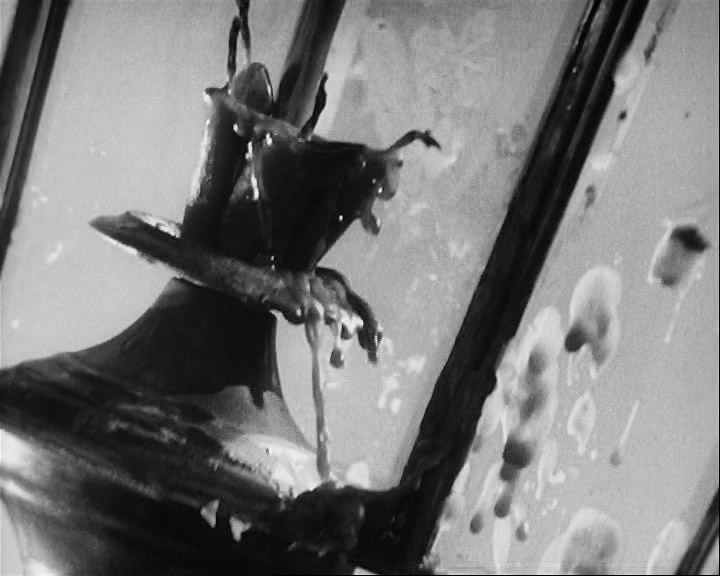
Ah, the bureaucracy. Because, alas, the Soviet Union was by this point only very dubiously ruled by Soviets. The bureaucracy were at this point (1928-32) fairly clearly a ruling class- the Stalinists showing themselves unexpectedly good Hegelians by awarding such a prominent role to the ‘universal class’- but for all that, they get a hard time in the films of the period. In Kozintsev & Trauberg’s wonderful Odna, they co-operate with the kulaks in the attempted murder of a young female teacher who has been posted to a rural school, hiding their class collaboration behind revolutionary rhetoric. This is parallelled in The General Line. Marfa and her proletarian helpers visit a government office, finding its cheroot-smoking inhabitants elegant and indolent, the lovingly shot machinery of the stenographers merely ineffectual- the effect of their initial refusal of the tractor application is shown, the hard physical drudgery of the harvest.
Initially obstructive and patrician, the bureaucracy are shamed into action by the worker- Eisenstein montages explosions into his outraged shout of ‘carry out the general line!’ Suddenly, shocked, they spring into life, sparking off activity, a mechanical chain leading to- oh yes- a gleaming new tractor. The odd half-honesty of this may have been one of the factors that worried Stalin so much about the film- he ordered several re-edits and a change of title to The Old and the New, diassociating it from party policy- but it is more ideological than that. The bureaucracy is a class that disavows its own existence and its own methods- here Eisenstein depicts the bureaucracy obstructing what was of course the bureaucracy’s own policy (the collectivisation of agriculture), one which massively extended its own power, and which led to famine and massacre on a huge scale.
In Dziga Vertov’s 1929 documentary Man with a Movie Camera the bureaucracy are similarly mocked, but a wholly absent from the follow-up, the ‘Industrial Symphony’ Enthusiasm , a hymn to the Five Year Plan, filming the industrialisation of an area of the Ukraine. The film is remarkable first of all for its sound design, the extreme innovation of which was parallelled at the time- for instance Shostakovich’s collages for Odna, using radio static, public address systems and theremins along with his own compositions, here in short stabs, commenting dialectically on rather than soundtracking the action. Sometimes when the characters speak we hear their voices- sometimes there are intertitles, giving a shock effect to the interjection of the voice. Vertov takes this to astonishing extremes, creating a montage that pre-empts Pierre Schaeffer and musique concrete by nearly 15 years, manipulating and montaging industrial clangs and feedback scrapes into a brutal, colossal composite of lumbering power.
Compared with the earlier film this is almost painfully slow, replacing its effervescence with a pounding, sluggish gait- every movement is shown as a struggle, as an achievement. The mingling of man and machine is here dirty, rough, and overtly sexual, all penetrating pistons and spilling fluids- here, pulsating, is Mendelsohn’s new living organism. And here too is the rejection and revival of religiosity. The film opens with the destruction of churches, crowds cheering at the dismantlement and mockery of the Orthodox Church. And later we see a group of young women shock-workers, beautiful and mechanistic with their thick, tension filled bodies- all chanting avowals of how much they will produce, like a kind of industrial liturgy. Stakhanovites as the Elect. Again and again we hear of the determination to fulfil the Five Year Plan in four years- ‘2+2=5’, as the slogan went. This obsession with targets, with fulfilling impossible quotas is stripped of its utopianism but is still very much present in today’s Market Stalinism, along with the disavowal of its own existence. The bureaucracy are the hidden force behind all that we see in Enthusiasm, the absent centre, directing all, issuing edicts increasingly out of touch with reality.
By the time the Five Year Plan had ended in the early 30s, films like these were literally illegal to produce, with Eisenstein’s techno-pastoral and Vertov’s ‘film-truth’ (suspiciously using actual footage) equally dubious to the consolidated bureaucracy. But in these films there is a grandiose consummation of the artist-soviet’s exultation of machine romanticism, socialism as new faith—what is absent is the ‘Soviet’ itself, ie the radical democracy that accompanied the early years of both revolutions, enabling the films to become the oblique self-portraits of a new ruling class. But running through them like electricity is the headiness of an actual revolution, a paradox Zizek describes as the ‘radical ambguity of Stalinism’. And it’s this, sitting so wonderfully incongrous in South Kensington, that we would imagine makes Simon Jenkins and his ilk so uncomfortable.
posted by owen hatherley # 7:23 AM 
Archives
May 2005 June 2005 July 2005 August 2005 September 2005 October 2005 November 2005 December 2005 January 2006 March 2006 April 2006 May 2006 June 2006 August 2006 September 2006 November 2006 February 2007 April 2007 May 2007 August 2007 November 2007 February 2008 June 2008 November 2008 January 2009 May 2009 June 2009 November 2009
did you agree to the measures taken?also
- Archinect
- Audacity
- Blueprint
- Building Design
- Frieze
- Historical Materialism
- MONU
- New Humanist
- New Statesman
- Nothing to See Here
- Perforations
- Socialist Review
- Socialist Worker
- The Weblog
- Wikipedia
- The Wire
- Ads Without Products
- Aloof From Inspiration
- Beyond the Implode
- Beyond Beyond the Implode
- Blissblog
- Degradation Ceremony
- End Times
- Entschwindet und Vergeht
- Fantastic Journal
- I Like
- The Impostume
- Infinite Thought
- Institute for Conjunctural Research
- Homo Ludens
- Kosmograd
- K-Punk
- Lenin's Tomb
- The Mire
- No Useless Leniency
- Poetix
- Screened Out
- Sea Songs
- Socialism and/or Barbarism
- Things Magazine
- Voyou Desoeuvre
- We Are Bad
- The Twentieth Century Society
- City of Sound
- The Sesquipedalist
- The Joy of Concrete
- no2self
- Architecture in Berlin
- City of Sound
- Entschwindet, das CV
- Dismantled King is Off the Throne
- SuperSpatial
- (what is this)
- Progressive Reactionary
- Russian Utopia Depository
- Maraid Design
- Sevensixfive
- Varnelis
- Architechnophilia
- Slab
- Part IV
- Strange Harvest
- Atelier A&D
- Archislave
- Candyland
- Flickr Brutalism
- From Here to Modernity
- Skyscraper City
- Monuments of the Future
- Archigram
- Chernikov Virtual Museum
- Chernikov Archive
- Gabion
- 0lll
- Shicklerart
- Constructivism in Arhitecture
- Unmitigated England
- YouTube Meades Shrine
- Enchanted Isle
- Boredom is always Counter-Revolutionary
- Antiflaneur
- Cracks in the Fabric
- Mapping Melbourne
- BLDGBLOG
- Lumpen Orientalism
- English Heretic
- Sub-Urban
- Punk Planning
- Subterranea Brittanica
- Diary of a Bluestocking
- Life without Buildings
- The Box Tank
- Condencity
- Nobody There
- Subtopia
- Metropolis
- aggregat4/5/6
- Architectures of Control
- The London Particular
- Ritual Landscape
- Dancing Bears
- Charles Holden
- London Destruction
- Derelict London
- Greenwich Phantom
- Classic Cafes
- London belongs to Me
- Transpontine
- Londonist
- Straight Outta Clapton
- London Transport Poster Archive
- Plakaty.Ru
- Revolution by Design
- Russian Poster
- Flickr USSR Posters
- Stefan Landsberger's Chinese Propaganda Poster Pages
- Russian Civil War Posters
- Stenberg Brothers
- Soviet Poster A Day
- The Poster Prop Page
- Russian Posters at allposters
- Militant Esthetix
- Savage Messiah
- Click Opera
- Snegourotchka
- New Plastic Ideas
- Modern Missives
- The Beasthouse
- Eurhythmania
- Petite Sophist
- Missing Dust Jacket
- Au carrefour étrange
- Triangular Sun
- Paperpools
- Feast of Palmer
- Cinders and Dust
- American Stranger
- Culturemonkey
- Enthusiasm
- Tom Roper's Weblog
- And you may find yourself...
- Rabbits, Toyen and so forth
- Grammar Police
- The Stomach Room
- Whore Cull
- Cigarette Smoking Blog
- Carceraglio
- David Byrne's Blog
- A Personal Miscellany
- &so this is christmas
- Taylor Parkes' Alternatives to Suicide
- smokewriting
- Cultural Parody Centre
- Tangerines in a Red Net Bag
- St Blaize
- Altering Labyrinth
- Colour of Memory
- Mountain7
- Chained to the Cinematheque
- Elusive Lucidity
- Faster than Instant Noodles
- Kino Slang
- Kinoblog
- Greencine Daily
- Senses of Cinema
- Girish
- Bright Lights after Dark
- Sphaleotas
- In The Realm of the Senses
- Raccoon: Notes and Scavengings
- Supposed Aura
- Roger Ebert
- Notes on Rhetoric
- Limited, Inc
- The Pinocchio Theory
- An und Für Sich
- Object-Oriented Philosophy
- Splintering Bone Ashes
- The Immeasurable Excess
- Bourgeois Sociology
- Jane Dark's Sugarhigh!
- Museum of Doubt
- Almost not There
- Planomenology
- Varieties of Unreligious Experience
- Random Variable
- Radical Philosophy
- Red Thread(s)
- Limited Language
- Lapsed Modernist
- Irrational Numbers
- Walter Benjamin Research Syndicate
- Long Sunday
- Metastable Equilibrium
- Larval Subjects
- Radio Free Narnia
- Hyperstition
- Reading the Maps
- Parole
- Herbert Marcuse Online
- Citta Violenta
- Ballardian
- Barbaric Document
- M John Harrison
- Mayakovsky and his Circle
- Troglodytes Troglodytes
- B.S Johnson
- Sir Percy
- heronbore
- interrupted transmission
- The Far Queue
- The Invaluable Marxists.org
- Chto Delat?
- Chto Delat Blog
- A Gringo in the Bolivarian Republic
- Marx and the Financial Crisis
- Radical Perspectives on the Crisis
- Little Red's Resolution Trust
- Mute
- Encyclopaedia of Decency
- Unstrung
- Louis Proyect, Unrepentant Marxist
- Iron Curtain Call
- Adventures in Historical Materialism
- Situationist International Online
- The Soul of Man Under Capitalism
- Speak You're Branes
- The Music of Weapons
- 3arabawy
- Virtual Stoa
- Green Galloway
- Further Left
- Counterpunch
- Dreaming Neon Black
- General, Your Tank is a Powerful Vehicle
- The Curmudgeonly
- Complex System of Pipes
- Apostate Windbag
- Progressive Gold
- Jews sans frontieres
- Somedisco
- Kotaji
- Qlipoth
- Praxis
- Bctzoiwp
- John Molyneux
- What in the Hell
- Le Colonel Chabert
- A Very Public Sociologist
- Through the Scary Door
- pas-au-dela
- Trinketization
- Law and Disorder
- Houzan Mahmoud
- Post-politics in Depth
- Mentasms
- Fangirl (archives)
- Skykicking
- Attic Plan
- Airport through the Trees
- Monster Bobby
- Run Away Home
- Quietus
- History is Made at Night
- The Blue In The Air
- Pop Life
- Uncarved
- Four Four
- Pop Feminist
- The Drexciya Research Lab
- Mapsadaisical
- Woebot
- Sasha Frere-Jones
- The Original Soundtrack
- House is a Feeling
- Popjustice
- Quiet Talks and Summer Walks
- Dissensus
- Blogglebum Cage
- Euro Like Me
- Backhaus
- Enthusiastic but Mediocre
- Goodnight London
- Dirrrty Pop
- Philip Sherburne
- FURTHER MISÅDVENTURES beneath the ÜNDERFELT of NØISE
- The Rambler
- Gutterbreakz
- Kid Shirt
- Trunk
- Kraftwerk
- Delia Derbyshire
- Fluxblog
- We are IE
- an idiot's guide to dreaming
- Blackdown
- polystyle desu
- Deeptime
- Ripley
- Les Temps Modernes

